What Is the Downside of Gutter Guards for a Sangaree Home?
Guards solve one problem well and create a few new ones, so it helps to know which ones before anything goes on your roof edge.
What is the downside of gutter guards?
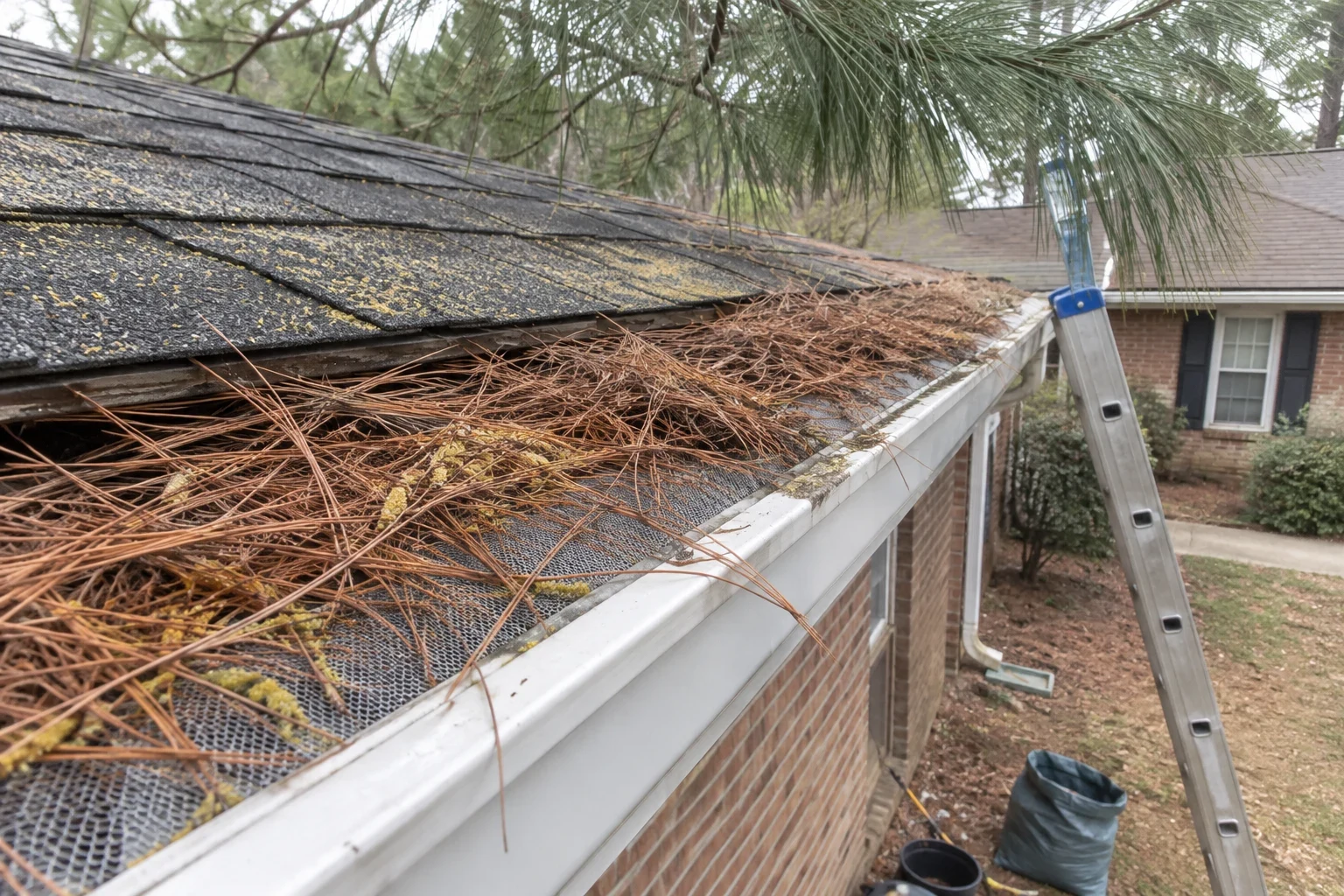
The main downside of gutter guards is that they reduce clogs but do not end them. Fine debris like pine needles, pollen and shingle grit can mat on top or slip through, heavy downpours can overshoot some designs, and a poorly fastened guard can lift shingles or hide a sagging gutter. For a free estimate, reach us at (843) 595-8808.
Do gutter guards clog?
Yes, though the clog moves. Without a guard, debris collects inside the trough. With one, it collects on top of the screen or wedges into the openings, where rain can no longer reach the gutter. A guard that is fully matted over sends water straight off the front edge, which is the same result as a packed gutter.
What sits on a guard depends on what grows over your home. Around Sangaree, pine needles and spring oak tassels are the usual trouble, and each behaves differently on a screen.
- Pine needles: thin enough to spear through perforated aluminum and coarse screens, then lodge upright and catch everything behind them.
- Oak tassels and pollen: soft and sticky, they form a felt-like layer on fine micro-mesh that sheds water instead of passing it.
- Shingle granules: grit from aging asphalt shingles settles inside the gutter even under a guard, slowly filling the bottom.
- Seed pods and small twigs: they bridge across slotted and reverse-curve openings and hold wet leaves in place.
Why do some guards overflow in heavy rain?
Reverse-curve and solid-hood products rely on surface tension. Water clings to the rounded nose and wraps into a slot below. In a steady rain that works. In a summer thunderstorm, when water comes off the roof fast and in a thick sheet, part of it jumps the curve and lands in your flower beds.
Roof valleys make this worse. A valley gathers runoff from two roof planes and dumps it on a short stretch of gutter, often more than any guard opening can take in at once. On those stretches we look at whether the guard type suits the flow at all, or whether a diverter or an open section is the better call.
What do roofers say about gutter guards?
Their main complaint is installation, not the product. Many guards are designed to slide under the first course of shingles. Doing that means lifting the shingle edge, which breaks the factory sealant strip along the bottom. A shingle that has lost its seal is easier for wind to peel back, and in a coastal storm that is where leaks and blow-offs start.
Roofers also object when guard screws or clips go through the drip edge or near roof nails, opening new paths for water into the fascia. The careful way is to fasten the back of the guard so it rests on or just under the drip edge without prying shingles up, and to secure the front lip to the gutter itself. That one detail decides whether a guard protects the roof edge or quietly damages it.
Can a guard hide a gutter that is already failing?
It can, and this is the downside people find out about last. A guard covers the trough, so you stop seeing standing water, rusted seams, loose hangers or a run that has lost its pitch. Meanwhile the extra weight of a guard plus wet debris pulls harder on hangers that may already be backing out of soft fascia.
Before we install guards, we check the gutter underneath: slope toward the outlet, hanger spacing and grip, seam sealant and the condition of the fascia board. If something is off, we tell you and show you, and gutter repair comes first. Putting a new guard on a sagging gutter only makes the eventual fix harder to reach.
- Standing water after rain means the pitch is wrong, not that a guard is needed.
- Hangers spaced too far apart let the gutter belly out under load.
- Dark streaks on the fascia point to water getting behind the gutter.
- Rust spots at seams tend to spread once covered and kept damp.
When is a guard worth it, and when is it not?
Guards earn their place on homes with heavy leaf fall, steep or high roofs where reaching the gutter is risky, and gutters that are otherwise sound. Matching the screen to the debris matters most. Fine micro-mesh suits oak and pollen but needs a stiff frame so it does not sag; a sturdier perforated panel holds up better against needles that bend thin mesh.
They are a poor fit when the gutters themselves need replacing soon, when the roof is near the end of its life and shingles will be torn off anyway, or when there is little overhead tree cover to begin with. In those cases the money is better spent on gutter installation or repair. Some homeowners also compare guards with solid gutter covers, which shed more debris but are more sensitive to heavy rain overshoot.
More questions about gutter guards
- Do gutter guards still need maintenance?
- Yes. Expect to brush debris off the top surface now and then, especially after spring pollen and fall needle drop. Fine grit can still build up inside, so the guard should be removable without bending it.
- Why do some new homes not have gutters?
- Builders sometimes leave them off to save cost, since many codes do not require them. Without gutters, roof runoff splashes against siding and pools near the foundation, which is why many owners add them later.
- Will gutter guards stay on in strong wind?
- A guard held only by friction or clipped loosely can lift in storm gusts. Guards fastened with screws to the gutter lip at close spacing, and not pried under shingles, hold far better through hurricane season.
- Can guards be added to the gutters I already have?
- Usually, if the gutters are sound and properly pitched. We check that first and tell you plainly if repair or replacement should come before any guard.
Find out if guards fit your gutters
We will look at your gutters, the trees over them and the roof edge, then tell you which guard suits your home or whether repair should come first. The estimate is free and comes with a clear explanation of why.